Please check if the feature has not already been requested.
If not, please describe it

 HLAPI - Possibility to create Components based Item for Assets as in Legacy API
Hello,
Is it possible to add the endpoints responsible for linking a Component to a given Asset?
For example; I want to create an item based on a DeviceHardDrive Component (with an ID of 2) for an Asset (a Computer with the ID 100). With the legacy API I can do the following:
https://{{GLPI}}/apirest.php/Computer/:computerId/Item_DeviceHardDrive/
With the corresponding payload:
{
    "input": [
        {
            "items_id": 100,
            "itemtype": "Computer",
            "deviceharddrives_id": 2,
            "capacity": 9314000,
            "serial": "abc123",
            "entities_id": 0,
            "busID": "1",
            "otherserial": "otherSerial_def456",
            "locations_id": 1,
            "states_id": 60
        }
    ]
}
This will create an item DeviceHardDrive which will be linked to Computer 100.
After searching a while in the SwaggerUI of the High Level API, I didn't find an endpoint which describes the following behavior.
So I started to make web search, to confirm if I'm simply blind and that I didn't see the endpoint(s) that I was searching for.
I found this topic that clearly says that this behavior is not currently available but, that we have to follow the changelogs until it appears:
https://forum.glpi-project.org/viewtopic.php?id=293852
Then I searched on the official GitHub repository of GLPI if a PR is on progress (or if an issue exists) for this feature but, I didn't find one (I was filtering with the label api though) so, that's the reason why I am posting this feature request.

Add PON (Passive Optical Network) as a standard Network Port type [Feature Request]
Current situation:
Currently, GLPI supports various network port types (Ethernet, Wifi, Port Aggregation, Alias, Dialup, Loopback, Fibre Channel). However, there is no dedicated type for PON (Passive Optical Network) technologies like GPON, XGS-PON, or EPON.
Why it's needed: With the massive growth of FTTH (Fiber to the Home) and POL (Passive Optical LAN) deployments, managing equipment like OLTs (Optical Line Terminals) and ONTs/ONUs (Optical Network Units) in GLPI is difficult using only the "Ethernet" or "FC" types. PON ports behave differently – they are point-to-multipoint and require specific attributes.
Proposed change:
- Add PON as a new entry in the
Network Porttype dropdown. - (Optional but recommended) Allow adding specific attributes for this port type, such as:
- Optical Power (TX/RX)
- ONT ID / ONU ID
- VLAN Configuration (Service/Management)
- Splitter Ratio
Benefit: This will allow network administrators and ISPs to accurately document modern fiber-optic infrastructure within GLPI without using "workarounds" or generic port types.
Currently, this lack of a dedicated PON type significantly impacts the GLPI Inventory module. When using the GLPI Agent to discover and import network equipment (such as OLTs or high-end routers), all fiber-optic interfaces are automatically classified under the generic 'Ethernet' type.
This creates several issues:
- Data Inconsistency: Network administrators cannot easily filter or report on actual fiber infrastructure vs. copper connections.
- Manual Overhead: After every synchronization, users have to manually correct the port types to reflect the real-world physical layer, which defeats the purpose of automated inventory
- Improper Mapping: Standard Ethernet attributes don't always align with PON-specific logic (like shared bandwidth or passive splitting), leading to a messy documentation structure.
Integrating PON as a native type would allow the GLPI Agent to correctly map these interfaces during the XML/JSON import phase, ensuring that the CMDB remains a 'Single Source of Truth' without constant manual intervention.

Rotate an image automatically or suggest
Be able to rotate an image within an image when displaying from a ticket
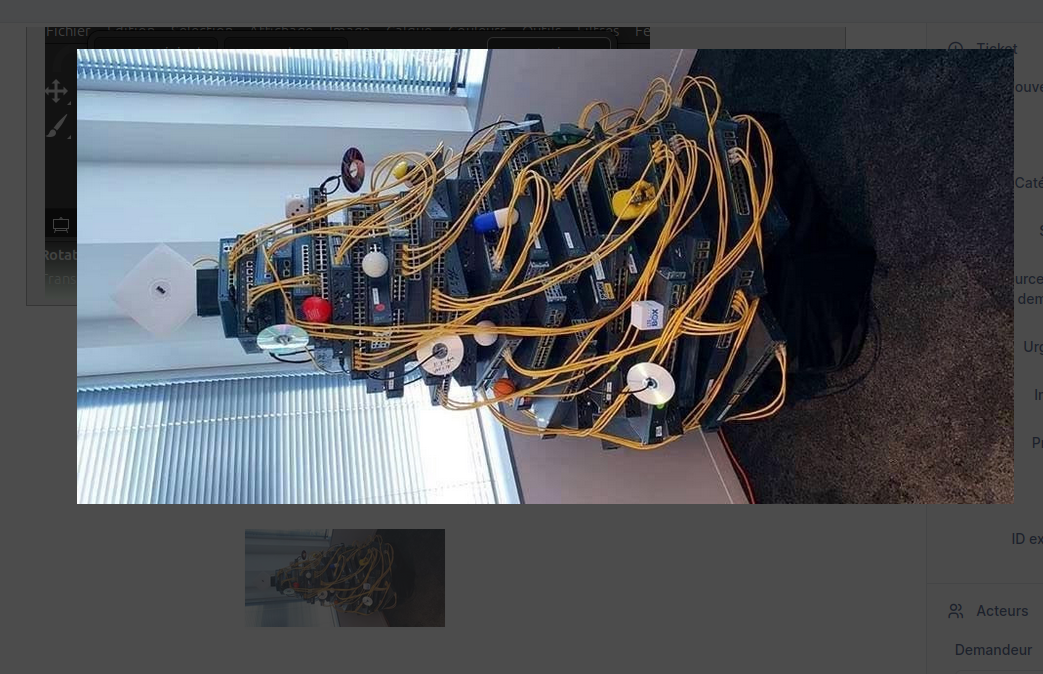

Set impact from form
It would be nice to be able to set the impact from in forms, not just urgency

Ability to change the order of tasks in ticket templates
It could be great if we can change the position of each task in a ticket template because some tasks needs to be done before others.

[Feature Request - GLPI 11] UX Improvement: Grouping items in the "Assets" menu
Bonjour l'équipe et la communauté,
Je souhaite proposer une amélioration concernant l'interface utilisateur de GLPI 11, spécifiquement au niveau du menu Parc (Assets).
Le constat : Actuellement, tous les types d'équipements (Ordinateurs, Moniteurs, Réseau, Imprimantes, Périphériques, etc.) sont listés au même niveau sous le menu "Parc". Avec l'ajout d'objets personnalisés, cette liste devient très longue et difficile à scanner visuellement.
La proposition : Serait-il possible d'introduire une fonctionnalité (native ou via configuration UI) permettant de créer des sous-groupes visuels ou des séparateurs dans ce menu ?
L'idée n'est pas de changer la structure de la base de données, mais uniquement l'organisation visuelle du menu.
Exemple d'organisation :
Parc
--- Infrastructure --- (Séparateur ou Sous-menu)
Réseau
Rack
PDU
--- Postes de travail ---
Ordinateurs
Moniteurs
--- Périphériques ---
Imprimantes
Téléphones
Cela améliorerait grandement la navigation au quotidien pour les techniciens. Qu'en pensez-vous ?
Merci pour votre excellent travail sur la v11 !

 [Question] Will file uploads on public forms return in GLPI 11?
Hello GLPI Team,
We were wondering if there are any plans to re-introduce file uploads on public (anonymous) forms for the GLPI 11 release.
We understand this feature was removed due to major security concerns, but it is a very valuable feature for many workflows.
Is a new, more secure implementation being considered or planned for version 11?
Thank you for your hard work!

Automatic Patch/Firmware Update
Hello Team,
Hoping you appreciate my Suggested Feature.
Instead of Updating GLPI in the Backend,
We are hoping the update will be run through the GLPI Directly. We will have an option to update the GLPI once a new version is released without Configuring the backend ( for non-technical Users ).
1. System will Check for GLPI Update
2. Once GLPI has a new Version, the System will provide a button or field for the Update
3. The System will update it self without the interaction in the Server ( For non-technical Users )
Thanks,
Regards,
Joseph T.


Geolocalização no GLPI Agent
Essa possibilidade talvez seja interessante olhando para gestão de ativos,
Utilizar o agente para coletar informações de geolocalização (GPS se disponivel, por IP Publico ou Serviços de localização do SO) e envia-lás junto aos dados de coleta do agente, coletando a geolocalização real/aproximada do dispositivo ao sincronizar o agente, podendo monitorar o deslocamento do equipamento.
Sei que já existem campos nativos que podem receber essa informação de forma manual mas acabo pensando nisso em relação a monitoria mais ativa dos equipamentos, tendo em vista os cenários mais comuns de deslocamento com dispositivos e imagino ser algo que agrega valor ao agente com um nivél mais alto de rastreabilidade.
Service d'assistance aux clients par UserEcho